Toyota Plans $1.3 Billion EV
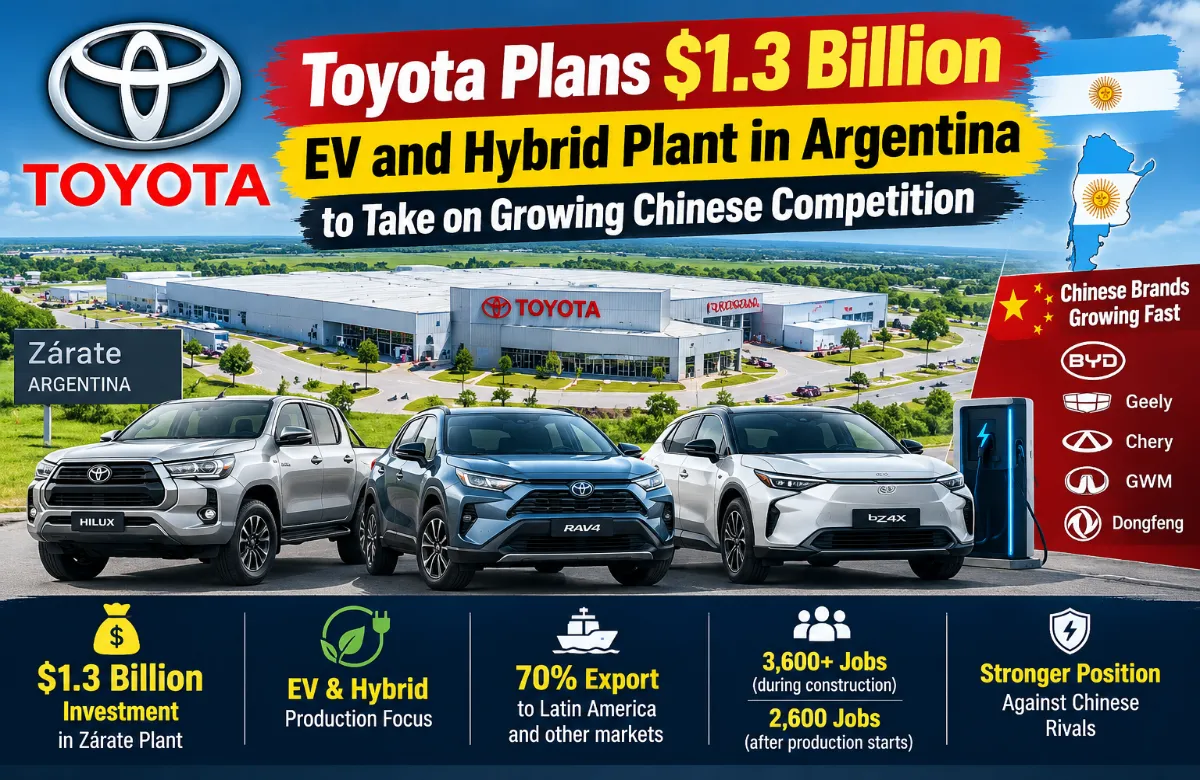
Toyota is preparing to make a major investment in Argentina as the Japanese automaker looks to strengthen its position in Latin America’s rapidly changing vehicle market. The company plans to invest around $1.3 billion in a new production facility at its Zárate plant.
The investment will focus on producing electrified vehicles and could become one of Toyota’s biggest manufacturing projects in the region. The company has not yet revealed the exact model that will be produced at the new facility, but the project is expected to support its growing EV and hybrid vehicle strategy.
Chinese Automakers Are Expanding Rapidly
Toyota’s investment comes at a time when Chinese automakers are rapidly increasing their presence across Latin America. Brands such as BYD, Geely, Chery, GWM and Dongfeng are expanding their sales networks and introducing more affordable electric and hybrid vehicles.
Argentina has also seen a noticeable rise in Chinese vehicle sales. Their growing market share is putting additional pressure on established manufacturers to offer more competitive electrified models.
Toyota’s decision to increase local production could help the company respond more quickly to this changing competitive landscape while reducing its dependence on imported electrified vehicles.
What Will Toyota Produce at the New Plant?
Toyota has not yet confirmed the name of the vehicle that will be manufactured at the upgraded facility. However, reports have linked the project to future electrified versions of vehicles already associated with Toyota’s Argentine operations.
The Zárate facility currently produces models including the Hilux pickup and SW4 SUV. Toyota has operated the plant since 1997, making it an important part of the company’s manufacturing network in Latin America.
The new investment could allow Toyota to add electrified technology to its locally produced vehicle range while using the existing manufacturing infrastructure.
A Major Export Opportunity for Argentina
One of the most important aspects of the project is its focus on exports. Toyota is expected to use Argentina as a production base for supplying electrified vehicles to other markets across Latin America.
A significant portion of the vehicles produced at the facility could be exported, giving Argentina a larger role in Toyota’s regional electrification strategy.
The project is also expected to generate thousands of direct and indirect jobs during the investment and production phases. For Argentina’s automotive industry, the investment could provide a significant boost to manufacturing, suppliers and related businesses.
Why Argentina Matters to Toyota
Argentina has long been an important production hub for Toyota, particularly for pickup trucks and commercial vehicles. The company’s decision to expand into electrified vehicle manufacturing shows how quickly the regional automotive market is changing.
Local production could give Toyota greater flexibility in responding to consumer demand while helping the company compete with manufacturers that are entering Latin American markets with aggressively priced EVs and hybrids.
The investment also strengthens Toyota’s long-term commitment to Argentina at a time when the country is trying to attract more automotive and industrial investment.
EV Competition in Latin America Is Heating Up
The new project highlights the growing competition between traditional global automakers and Chinese manufacturers in Latin America’s electrified vehicle market.
Toyota has built a strong reputation for hybrid technology, but Chinese brands are increasingly competing with a wider range of fully electric and hybrid vehicles. As charging infrastructure improves and consumers become more interested in electrified mobility, competition is expected to intensify.
If Toyota moves forward with the planned $1.3 billion investment, its Zárate facility could become an important production center for electrified vehicles in the region. The project could also help Toyota defend its market position as Chinese automakers continue their rapid expansion across Latin America.
About The Author