A parked truck is supposed to stay put. When one doesn’t, the results can range from a dented garage door to a serious injury. That is why searches for the Ford truck rollaway defect settlement keep drawing attention from owners and shoppers.
Before you assume anything about compensation, you need to separate four things that often get blurred online: an allegation, a lawsuit, a recall, and a court-approved settlement. This guide explains each and shows how to check your own truck.
Status check: As of [DATE OF VERIFICATION], the status of any rollaway-related Ford settlement is [CONFIRMED STATUS: e.g., “no approved settlement found” / “pending class action” / “approved settlement”]. Verify this against the sources listed below before relying on it.
What Does “Rollaway” Actually Mean?
A rollaway happens when a vehicle that should be held in place moves on its own. In an automatic-transmission truck, Park normally locks the drivetrain with a small metal part called a parking pawl, which engages a notched wheel inside the transmission. If something prevents that from working as designed, the truck can creep or roll, especially on a slope.
Modern trucks often use electronic gear selectors instead of a traditional shift lever. In those systems, software and sensors tell the transmission what the driver selected. A fault in that chain, or in a related mechanical part, could in theory affect whether the truck holds in Park.
Not every Ford truck shares the same design. Concerns documented for one model, engine, or production period say nothing about another.
Allegation, Lawsuit, Recall, Settlement: Know the Difference
- Allegation: A claim, often from owners or plaintiffs, that has not been proven.
- Lawsuit or class action: A court case where owners say a defect caused harm or loss. Filing a case does not prove the claims.
- Recall: A remedy process tied to a safety defect or noncompliance, usually involving the manufacturer and NHTSA. Repairs are normally free.
- Settlement: An agreement that resolves a lawsuit, often needing court approval. Only an approved settlement has claim rules and deadlines.
A recall is not a settlement, and a lawsuit is not a settlement. Only the last item can pay eligible owners.
Which Ford Trucks May Be Affected?
Ford’s lineup includes the F-150, Super Duty F-250 and F-350, and other trucks. But a model should be called “affected” only when an official record says so.
Fill this section from verified records only:
- Recall or investigation number(s): [NHTSA campaign number(s) or investigation ID(s)]
- Models and model years: [as listed in the official notice]
- Reported problem: [description from the notice, such as the specific component or software involved]
- Configuration or production-date limits: [if stated]
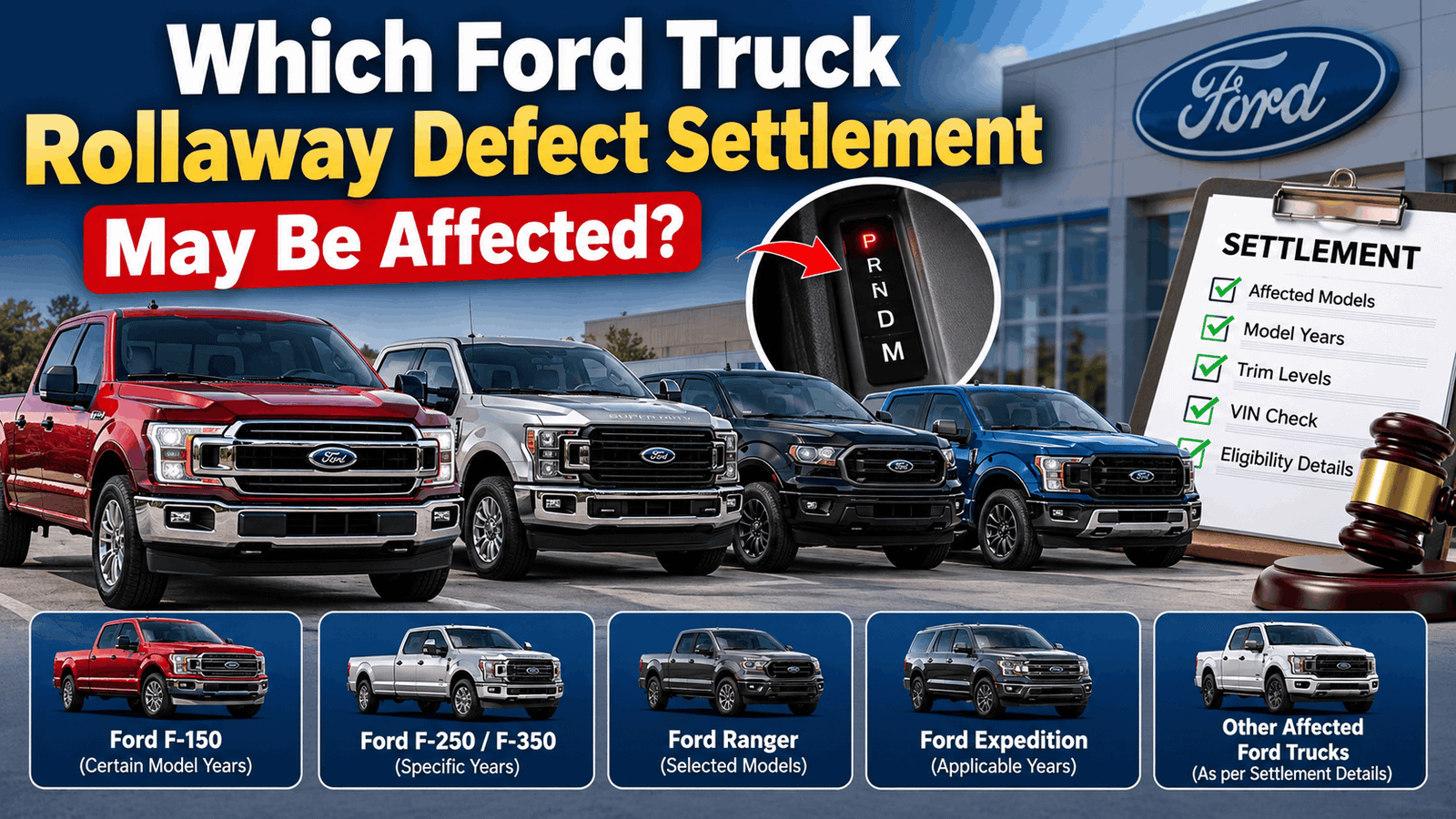
If you find no settlement-specific vehicle list, say so plainly: “No official list of settlement-eligible vehicles has been confirmed.” Do not infer one from a recall list, because the two can cover entirely different vehicles.
Ford Truck Rollaway Defect Settlement: Legal Update
Here is what you need to establish and report accurately:
- Has a settlement been announced or approved? [Yes/No, with court name, case number, and approval date]
- Has a class action been filed? [Court, filing date, named defendants]
- What do plaintiffs allege? Describe these as allegations, never as proven facts.
- What has Ford said? [Quote or summarize only from a documented public statement]
- Deadlines: [Claim, opt-out, or objection dates, only if an official notice exists]
The Ford truck rollaway lawsuit coverage you find online may mix these categories together. Court dockets and official settlement websites are more reliable than summaries.
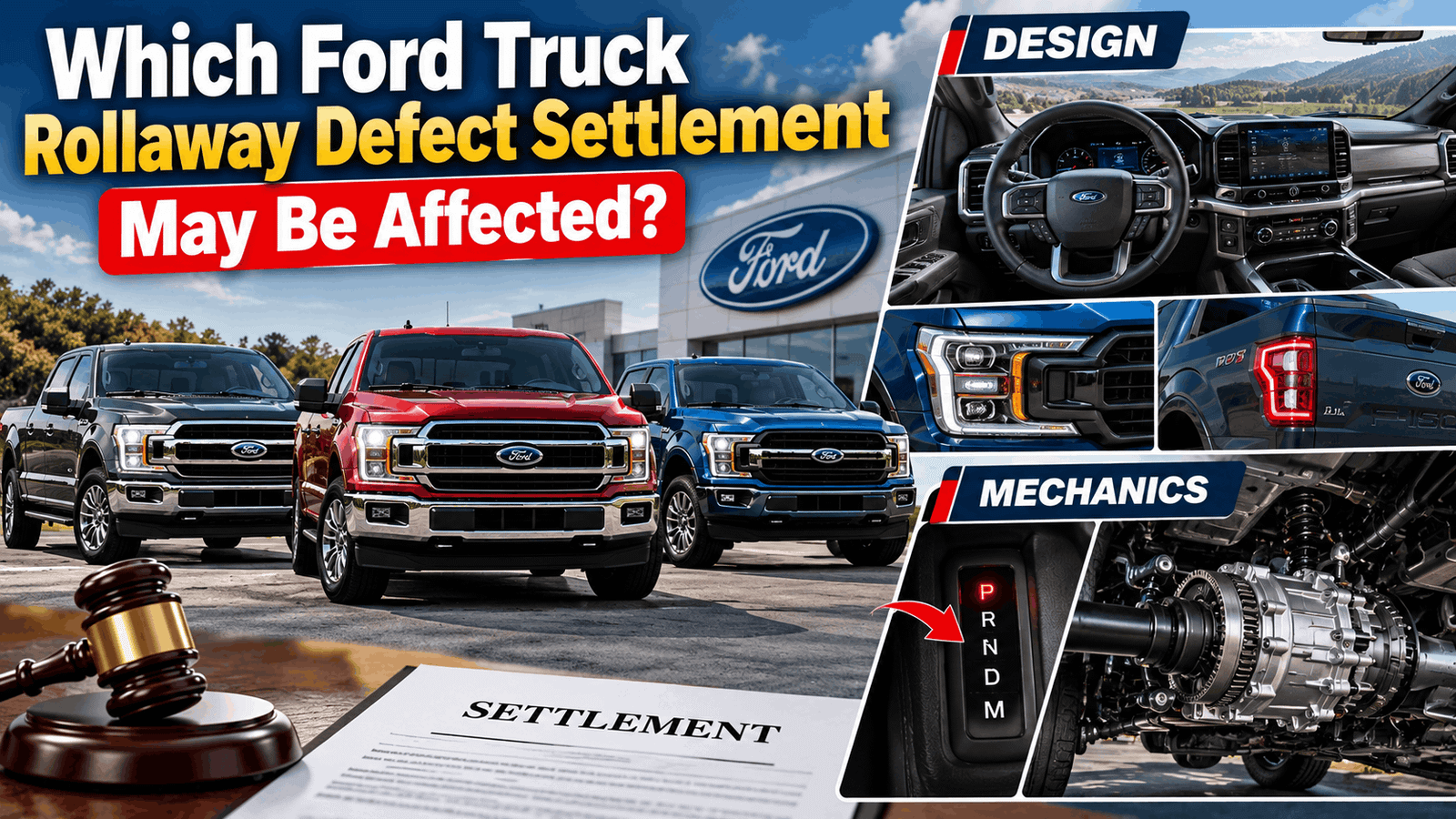
How Design and Mechanics Relate to Rollaway Risk
Keep this section tied to the documented defect. Depending on what the records show, these systems may be relevant.
Controls and the cabin
- The gear selector or electronic shift control.
- Park indicators and dashboard warnings, which tell you what gear the truck believes it is in.
- The owner’s manual procedure for securing the truck.
Around the truck
- Sloped driveways and parking areas make any unintended movement more dangerous.
- Nearby vehicles, structures, and people are the ones at risk if a truck moves.
Mechanical systems
- The transmission and parking pawl.
- Shift-by-wire systems on trucks equipped with them.
- The parking brake, which is a separate system from Park and an important backup.
Do not attribute a rollaway to styling, trim, or cosmetic features. Nothing in the available evidence supports that.
Who May Qualify for Compensation?
If an approved settlement exists, its official notice controls everything. Typical eligibility factors include:
- Ownership or lease status at a specific time.
- VIN and model-year coverage. A VIN lookup tool is common in settlements.
- Purchase or lease dates falling within a set window.
- Repair records showing a related fix, if required.
- Proof of expenses or damages such as invoices or incident reports.
- Deadlines and exclusions. Late claims are usually rejected, and some categories of loss may be excluded.
If no confirmed settlement exists, no claim process is open. Be wary of websites that collect personal information for a “claim” without linking to a court-approved notice.
How to Check Your Truck, Step by Step
- Find your VIN and model year. The VIN is on the driver-side dashboard near the windshield and on your registration and insurance card.
- Search NHTSA.
- Check Ford.
- Look for official settlement notices. Seek court-approved notices or case documents, not third-party summaries.
- Keep records. Save repair invoices, recall letters, purchase or lease paperwork, and any incident documentation.
- Contact an authorized Ford dealer if you have a documented concern about your truck.
- Consider legal advice if you believe you suffered a loss.
A clean recall check does not mean you are ineligible for a settlement, and an open recall does not mean you are eligible for one. Those are separate questions.
What to Do If Your Truck Might Roll Away
Start with the basics. Follow your owner’s manual, apply the parking brake as instructed, and park in a safe spot, ideally on level ground. If a recall notice gives specific instructions, follow them promptly.
If your truck moves unexpectedly or cannot reliably stay in Park, stop using it once it is safe to do so and contact Ford or an authorized service provider. Do not try to reproduce the problem yourself. Testing a suspected rollaway on a slope can put you and others in danger.
Frequently Asked Questions
Is there an official Ford truck rollaway defect settlement?
That depends on current court records. As of [DATE], [STATUS]. Confirm before acting.
Which Ford truck models and years may be affected?
Only vehicles named in official recall, investigation, or settlement documents. See the section above for [VERIFIED LIST OR “no confirmed list”].
How can I check whether my truck has a related recall?
Use your VIN on NHTSA’s recall page and Ford’s recall page.
Can Ford truck owners receive compensation?
Only through a recall repair, a court-approved settlement, or a successful legal claim. None is guaranteed, and not every owner qualifies.
What documents may I need for a claim?
Typically your VIN, proof of ownership or lease, repair invoices, and any records of related losses. The official notice lists exact requirements.
Is a recall the same as a class-action settlement?
No. A recall provides a repair. A settlement resolves a lawsuit and may provide payments or other benefits.
What should I do if my parked truck moves unexpectedly?
Make the situation safe, stop driving the truck when you can, and contact Ford or an authorized service center. Document what happened.
The Bottom Line
The key question behind any Ford truck rollaway defect settlement search is simple: what is officially confirmed today? Check Ford truck recall updates from NHTSA and Ford, verify any Ford settlement eligibility rules directly from court-approved notices, and keep your records organized. Treat any Ford truck safety defect concern seriously by following official guidance.
About The Author